"Keep Going": IMU to install sculpture honoring Ryan White
By:Yaël Ksander
Monday, December 01, 2025
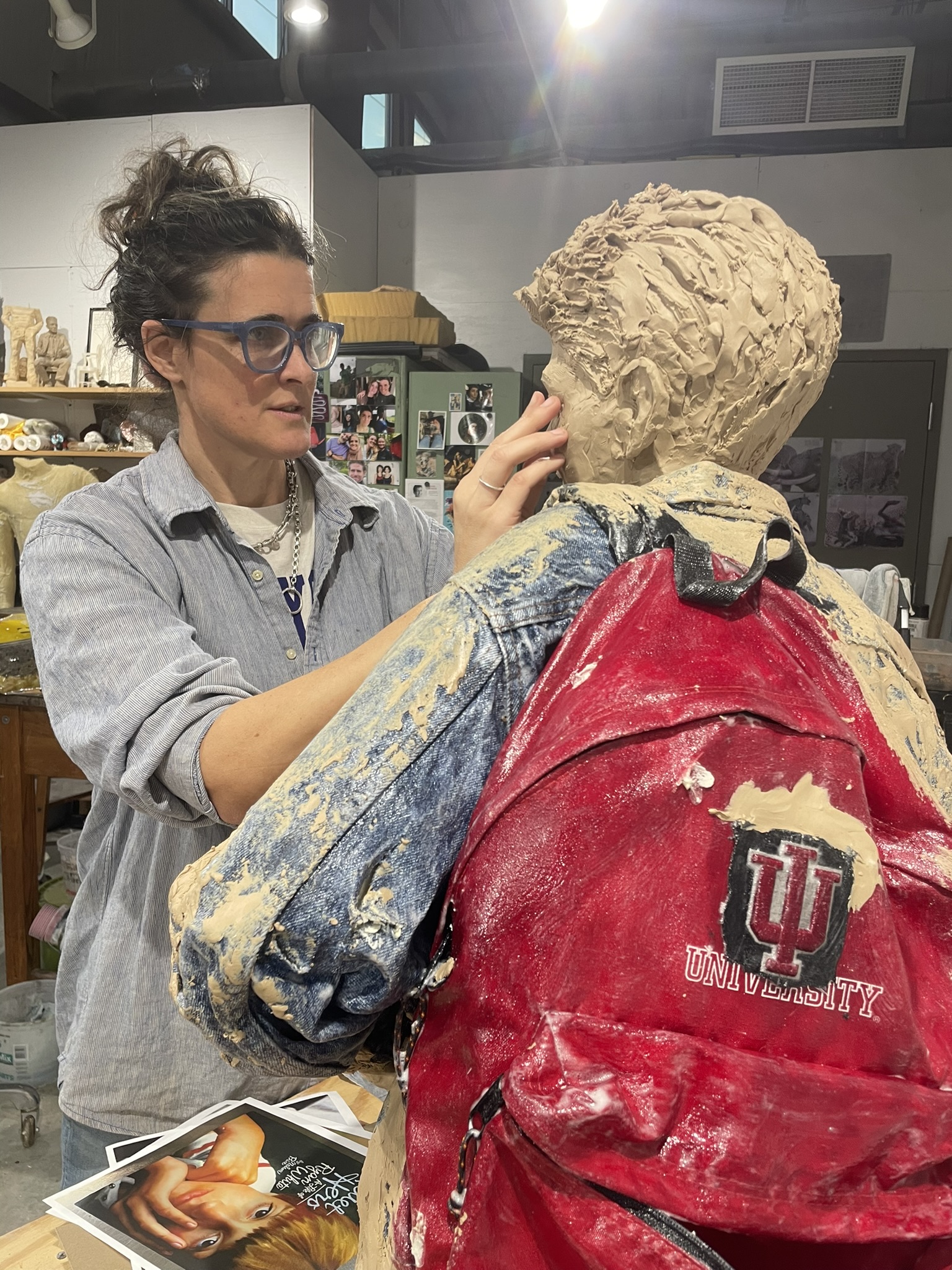
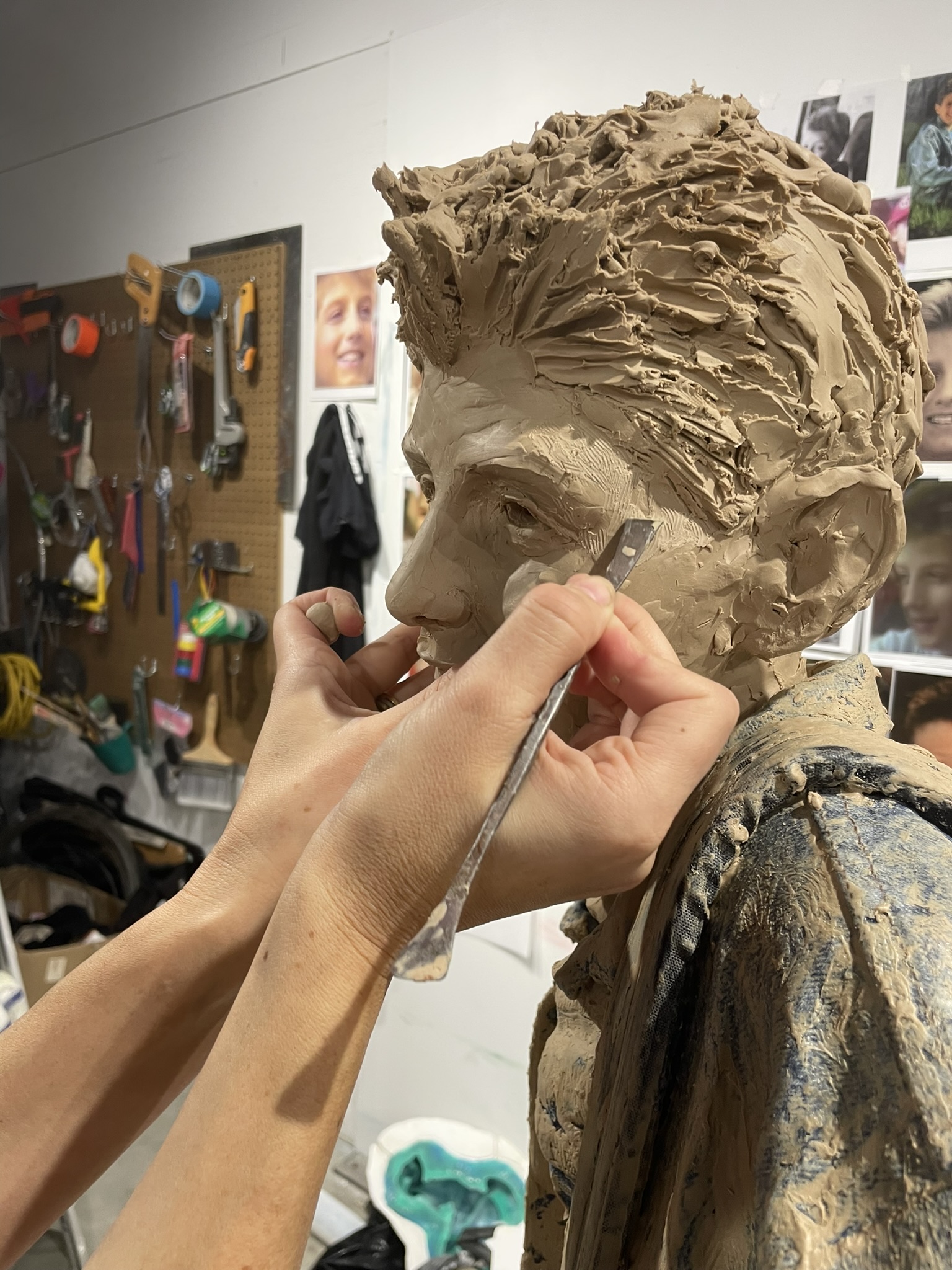
Melanie Pennington at work on the Ryan White sculpture. Yaël Ksander
He befriended pop stars, generated philanthropic giving, inspired the single largest federal program for people with HIV/AIDS in the United States, and lived his life as a master class on thwarting stigma. A more personal goal, however, eluded the teenage sports fan from Kokomo, Indiana: to attend Indiana University. Ryan White died a month shy of his high school graduation.
But in the spring of 2026, Ryan will finally make it to campus. Thirty-six years after White’s death of AIDS-related complications in April 1990, a bronze sculpture of the legendary Hoosier will be installed in Bloomington's Indiana Memorial Union (IMU).
Like many of the students who gather there to study and socialize, Ryan will be wearing a jean jacket and an IU backpack, albeit cast in bronze. The work of Melanie Cooper Pennington (M.F.A. ‘16), senior lecturer and area head of sculpture in the Eskenazi School of Art, Architecture + Design, the memorial was proposed by Dr. William Yarber, provost professor in the IU School of Public Health-Bloomington and the senior director and founder of the school’s Rural Center for AIDS/STD Prevention (RCAP), who has also made the initial major contribution to fund the gift.
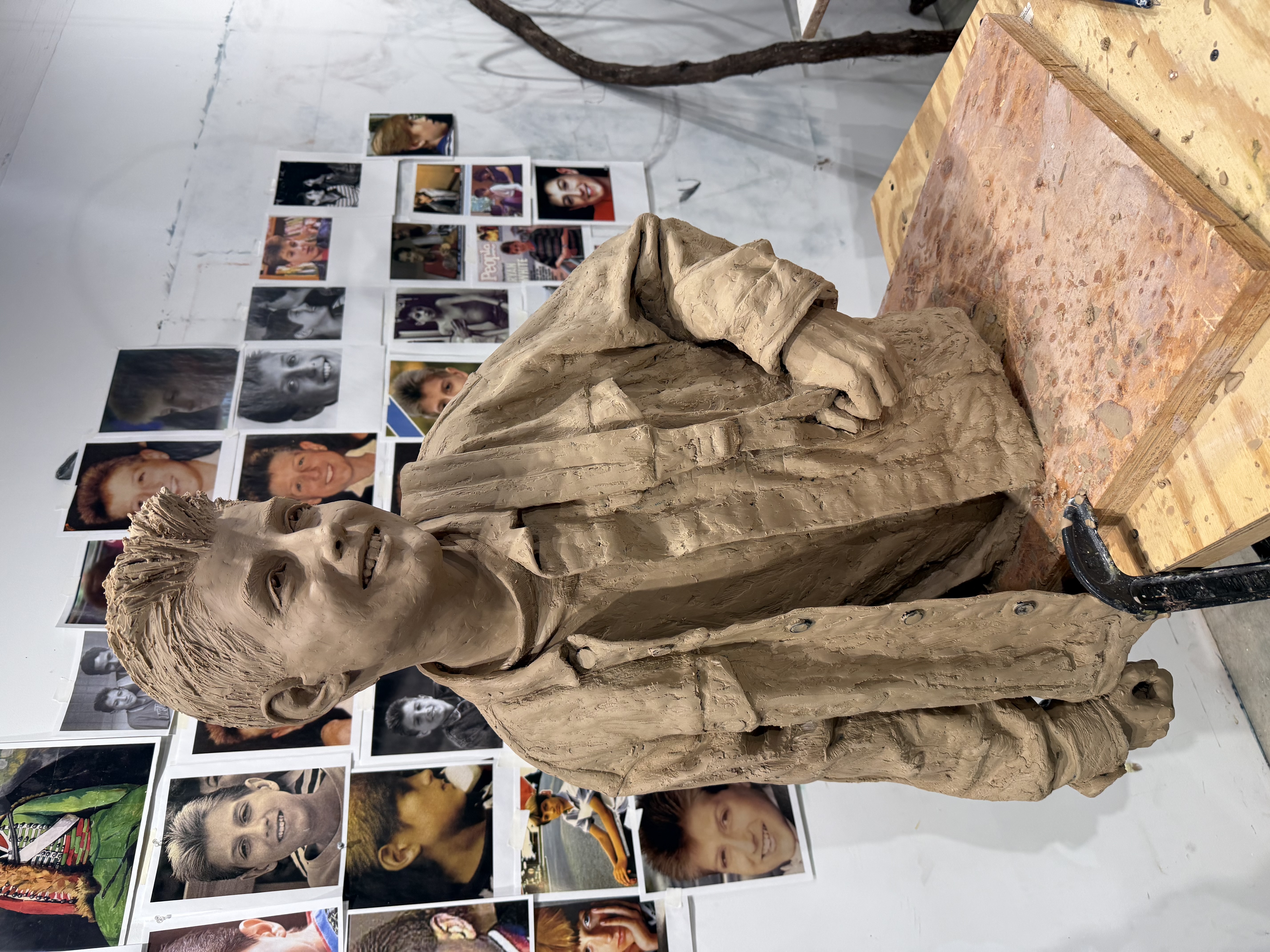
"Keep Going," Melanie Pennington's original clay sculpture of Ryan White, will be cast in bronze.Courtesy of the artist
Pennington will offer first glimpses of the sculpture during the Ryan White Distinguished Leadership Award ceremony on Saturday, December 6. Held every year on Ryan’s birthday, the ceremony and award have long kindled White’s legacy at his university of choice. Recognizing those who have made significant national and/or international achievements in HIV/AIDS prevention, the award this year honors Jessica Leston, founder of The Raven Collective, for her national leadership in advancing HIV prevention and health equity in Indigenous communities. Created in 2009, the award has previously recognized leaders including public health officers Dr. Joycelyn Elders, Dr. Anthony Fauci, and Dr. C. Everett Koop, AIDS quilt creator Cleve Jones, Olympic diver and human rights advocate Greg Louganis, and Jeanne White Ginder, HIV/AIDS prevention educator and Ryan’s mother.
There was a worldwide response to a person in rural Indiana.
Dr. William Yarber, provost professor in the IU School of Public Health-Bloomington, senior director and founder of the school’s Rural Center for AIDS/STD Prevention
As she often does, Ginder will be attending this year’s ceremony. Pennington sought out Ginder’s input in developing the concept for the commemorative portrait. Ryan’s mother suggested the IU backpack, emblematic of her son’s dream of attending the university (fueled, she has said, by Coach Bob Knight’s promise of a full scholarship). Passersby will be able to leave notes of encouragement in a pocket in the backpack—or pick one up. Ginder’s description of Ryan’s positive spirit informed the sculpture’s striding pose and smiling expression—a spirit Ryan attributed to his mother, in turn. “AIDS can destroy a family if you let it,” Ryan said, “but luckily for my sister and me, Mom taught us to keep going. Don’t give up, be proud of who you are, and never feel sorry for yourself.”
Passersby will be able to leave or retrieve notes of encouragement in a pocket in the sculpture's backpack, cast from an actual IU model.Yaël Ksander
Ryan embodied his mother’s philosophy to “keep going” (the source of the sculpture's title) with his ceaseless activism. During the five and a half years he lived with HIV/AIDS, Ryan combatted and prevailed against discrimination born of ignorance and fear about the misunderstood illness. He defended his right to attend public high school, testified before the President’s Commission on AIDS, and captured the hearts of people around the world. The Kokomo teen is one of several prominent figures credited with having transformed the public perception of AIDS. “There was a worldwide response to a person in rural Indiana,” notes Yarber, who got to meet Ryan. Given the 1.2 million people in the U.S. currently living with HIV, Yarber adds, White's message of education and compassion remains urgent.
AIDS can destroy a family if you let it, but luckily for my sister and me, Mom taught us to keep going. Don’t give up, be proud of who you are, and never feel sorry for yourself.
Ryan White (1971-1990)
While White's legacy is larger than life, Pennington is simultaneously working to bring his humanness into the piece. Surrounded by dozens of photos of Ryan tacked to her studio wall, Pennington hopes to capture not only his likeness, but “the spirit that I’ve picked up researching him and watching his interviews,” she says. “There was a casual confidence that he had, a kindness, and an openness. I wanted to capture all of those things in the posture, in the movement, in his looking out at us while moving in another direction.”
At the same time, Pennington acknowledges, “He was a teenage boy! I’ve had a teenage boy.” Ryan drove a Mustang that Michael Jackson gave him, Pennington reports. “His mom said he liked to look cool.”
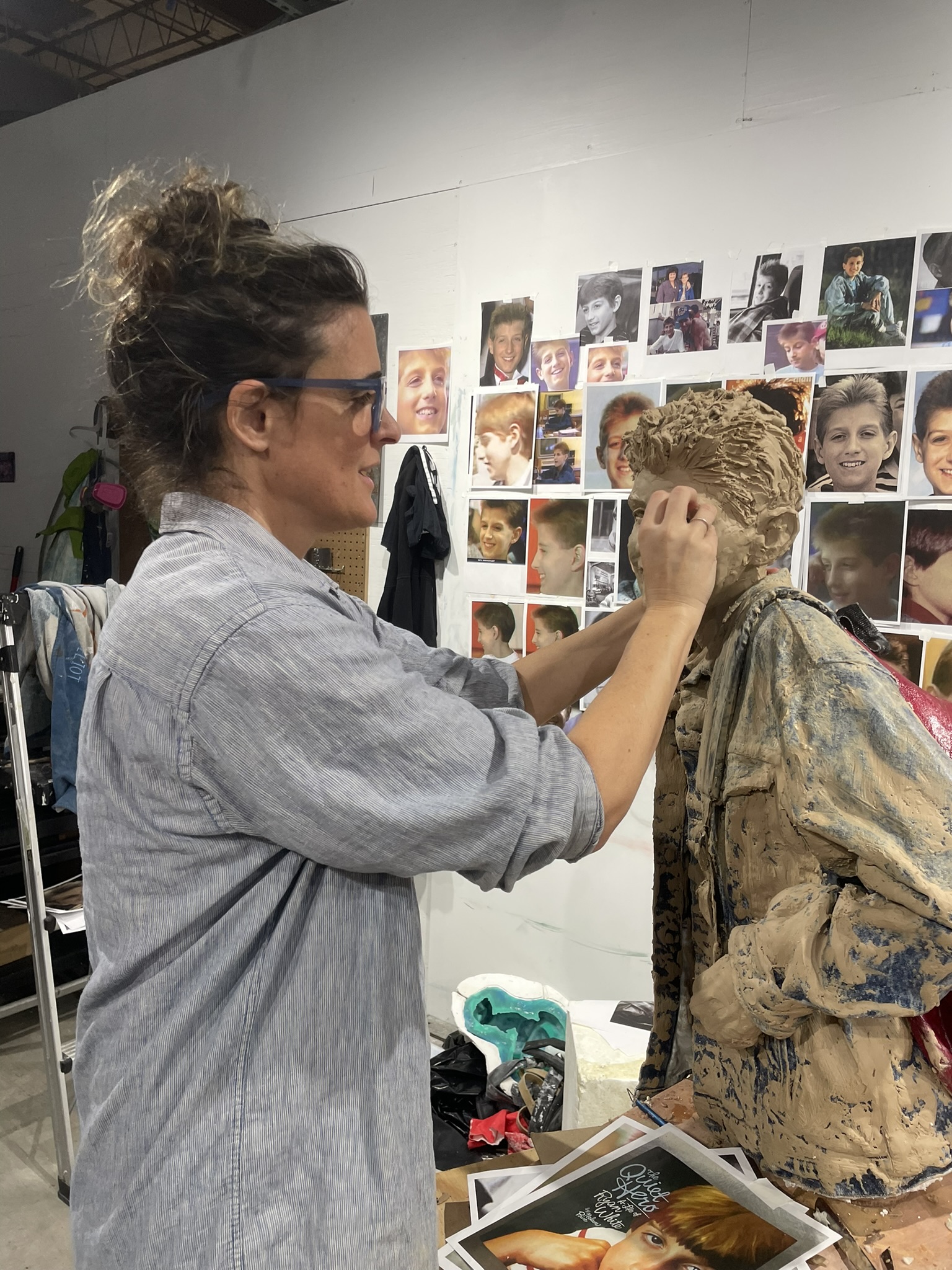
Pennington at work in the studio. Yaël Ksander
Capturing that cool—and his other intangible qualities—while ensuring an accurate likeness is a balancing act. Using Procreate, a digital drawing program, Pennington overlays photos of Ryan onto those of the work in progress. On an iPad next to her sculpting station, she toggles back and forth between photos of Ryan and those of the clay sculpture, comparing relationships between features to confirm that her representation is accurate.
Pennington, who has alternated between traditional sculptural portraiture and modernist, mixed-media abstraction for over three decades, deploys an equally diverse set of tools. Still, she says, “AI couldn’t give me a digital rendering of Ryan. Even with all the images of Ryan out there, AI couldn’t do it.” She is convinced that human empathy is the generative spark of this portrait. “I keep asking him to communicate with me,” she says. “If I can capture just a little bit of that spirit that this boy had! I’ve spent so many hours in here. My poor husband is like, ‘Are you coming home?’” Her standard reply: “’Not until I can feel him breathing!’”
If I can capture just a little bit of that spirit that this boy had! My poor husband is like, ‘Are you coming home?’... ’Not until I can feel him breathing!’
Melanie Pennington, senior lecturer and area head of sculpture in the IU Eskenazi School
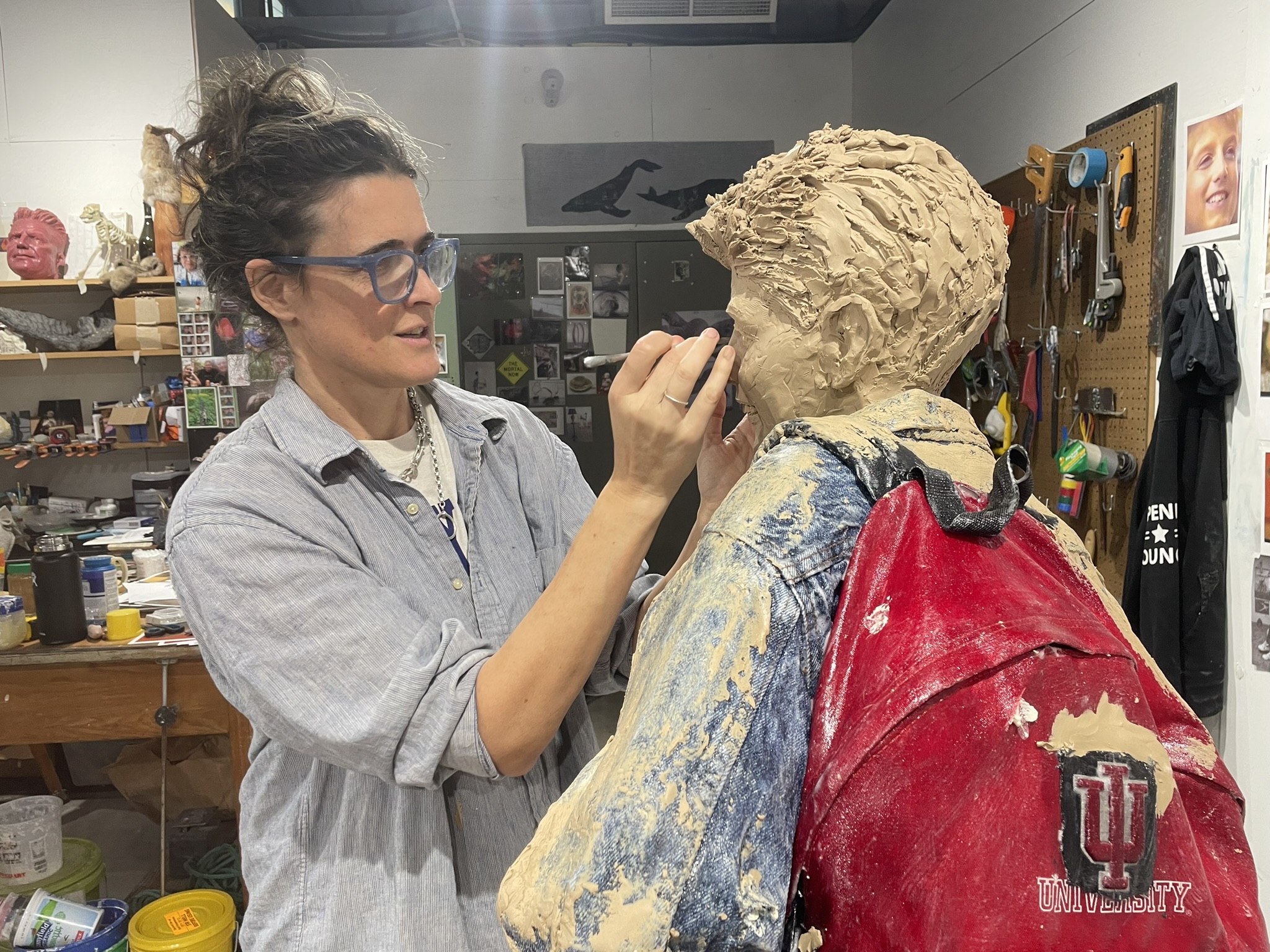
Breathing life into a statue has been the sculptor’s conceit since Pygmalion. If AI isn’t equal to the task, it might be a job for a tool that has stood the test of time. As we converse, Pennington points out the simple metal stylus she is using to carve Ryan’s cheek from the clay. It had belonged to her friend and mentor Christyl Ann Boger, an associate professor of ceramics in the Eskenazi School until she died in 2018. Given the task at hand, this memento mori could be the magic wand.
Pennington refines Ryan's likeness with the tool left by her late friend and colleague.Yaël Ksander
When the clay sculpture of “Keep Going” is complete, it will be shipped to the foundry to be cast. Upon its return, the waist-length bronze sculpture will be mounted on a limestone pedestal in the student union building, where it will become part of the IMU art collection. Part of IU’s Public Art and Cultural Heritage Collection, the IMU art collection was started in 1912, and regularly acquired works until the 1970s. According to IMU Executive Director Hank Walter, most works in the collection were purchased by the student-run Union Board, with funding by donations in recent years. Other works of art—such as the Ryan White sculpture—are donated, with approval from the Union Board.
(As to the precise placement of the sculpture: pending the structural engineers’ report that the 95-year-old floorboards can bear the weight of the bronze sculpture and its limestone pedestal, organizers are hoping to nestle Ryan beside the fireplace in the South Lounge.)
The commission has provided a valuable view for Pennington's students into the life cycle of a bronze portrait sculpture. Over the course of the fall semester, her Introduction to Figure Sculpture class has visited her studio every few weeks to observe the work’s evolution—from body casting to mannequin construction to rendering facial anatomy and expressions in clay. Although he passed away over 35 years ago, Ryan White is not a new name for many of her students, Pennington says. Every piece of apparel for the IU Dance Marathon—founded in his honor in 1991—bears his initials. At the Children’s Museum of Indianapolis, White is celebrated along with Anne Frank, Ruby Bridges, and Malala Yousafzai in a permanent exhibit that commemorates children who changed the world.
“It has been an honor to create a sculpture of Ryan and to share the process with my students,” says Pennington. “Ryan’s legacy continues to inspire students to fight for justice, embrace kindness, and pursue education.”